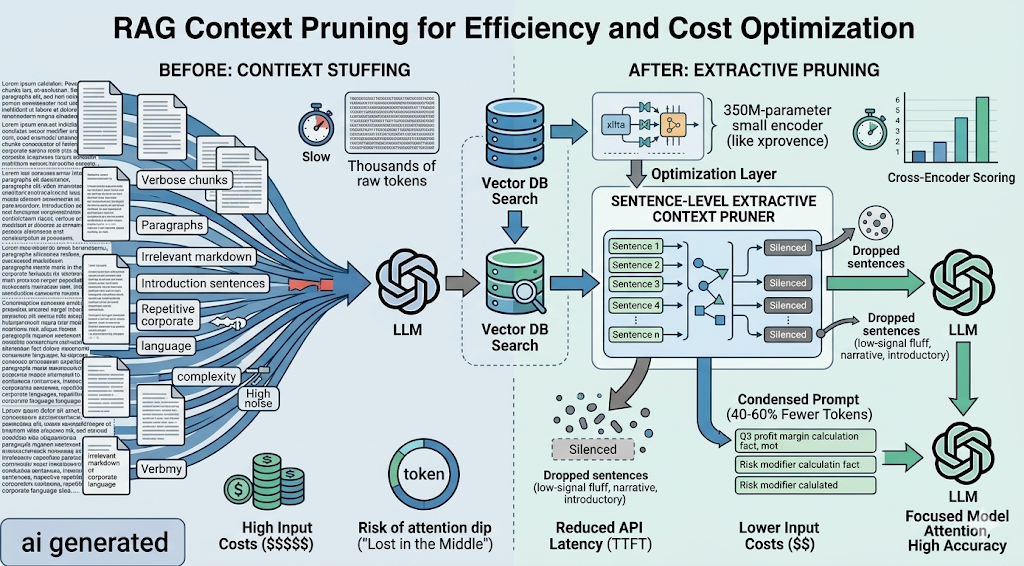
After baseline production runs across our clients’ financial discovery pipelines, we observed an increase in Time-to-First-Token (TTFT) when retrieved context exceeded 2,500 tokens. Furthermore, the system’s retrieval accuracy score decayed when the target information was located in the middle 40% of the injected payload. We addressed this bottleneck by deploying an inline sentence-level extractive context pruning layer directly inside the retrieval orchestration path. This architectural shift reduced our average input payload size by 54%, lowered API token spend, and stabilized downstream generation accuracy.
The Production Reality of Context Stuffing
We do not treat retrieved text chunks as immutable objects. Passing raw vector database outputs directly into a generative model’s context window degrades infrastructure performance. When a user submits a specific operational query, a standard semantic search over 512-token chunks returns extensive irrelevant information alongside the core answer.
Our internal profiling highlights three systemic infrastructure vulnerabilities caused by this approach:
- Attention Saturation (The “Lost in the Middle” Phenomenon): Attention mechanisms exhibit high sensitivity to tokens located at the absolute boundaries of the context window. When dense, low-signal data fills the intermediate token positions, the model’s multi-head attention weights fail to activate on critical data points located deep within the retrieved payload.
- Prefill Phase Latency Escalation: Downstream LLM API latency scales with prompt size. Massive prompt payloads force extended compute cycles during the KV-cache prefill phase, inflating overall end-to-end system latency.
- Unnecessary Capital Depletion: Passing structural boilerplate, markdown tables, and corporate fluff to external APIs incurs direct financial charges per token.
Extractive Context Pruning Architecture
We engineered a dual-stage filtration pipeline that intercepts retrieved data after the re-ranking phase but before prompt construction. Instead of using a costly LLM to summarize text—which introduces an unacceptable latency penalty—we deployed a lightweight, 350M-parameter local cross-encoder model trained for token and sentence utility evaluation.
graph TD
    UserQuery[User Query] --> VecDB[Vector DB Search <br/>Surfaces Top 50 Chunks]
    VecDB --> ReRanker[Cross-Encoder Re-Ranker <br/>Filters to Top 5 Chunks]
    subgraph Optimization Layer
        ReRanker --> Pruner[Extractive Context Pruner <br/>Scans Sentences, Drops Fluff]
    end
    Pruner --> CondensedPrompt[Condensed Prompt <br/>40-60% Fewer Tokens]
    CondensedPrompt --> LLM[Generative LLM <br/>Fast, Accurate Inference]
This configuration alters the pipeline data dynamics by isolating the raw extraction mechanics from the generative generation step:
| Pipeline Phase | Standard Production RAG | Pruned Context RAG |
| Retrieval | Vector DB Search (Top 50 Chunks) | Vector DB Search (Top 50 Chunks) |
| Re-ranking | Cross-Encoder Filters to Top 5 | Cross-Encoder Filters to Top 5 |
| Refinement | None (Passes unedited, raw chunks) | Sentence-Level Local Extractive Pruner |
| LLM Payload | Raw retrieved tokens | High-signal tokens |
| System Footprint | Elevated token costs; attention dilution | Low local overhead; optimized TTFT |
Production Pipeline Implementation
The system uses a custom ExtractiveContextPruner class that tokenizes raw documents into discrete sentence strings, pairs them against the incoming user query, and evaluates their relative importance using an on-premises transformer instance. We enforce explicit GPU allocation and memory tracking during this phase to prevent thread blockages under heavy load.
import os
import re
import numpy as np
import torch
from transformers import AutoModelForSequenceClassification, AutoTokenizer

class ExtractiveContextPruner:
    def __init__(self, model_name: str = "naver/xprovence-reranker-bgem3-v1"):
        """
        Initializes the local pruning transformer configuration.
        Enforces execution on available CUDA devices.
        """
        self.tokenizer = AutoTokenizer.from_pretrained(model_name)
        self.model = AutoModelForSequenceClassification.from_pretrained(model_name)
        self.model.eval()

        self.device = "cuda" if torch.cuda.is_available() else "cpu"
        self.model.to(self.device)

        # Unresolved Hack 1: This regex-based splitter fails on complex financial
        # tables and nested bullet points, occasionally truncating clean markdown strings.
        # We are actively hacking around this by injecting custom padding tokens.
        self.sentence_regex = re.compile(r'(?<!\w\.\w.)(?<![A-Z][a-z]\.)(?<=\.|\?)\s')

    def _split_into_sentences(self, text: str) -> list[str]:
        return [s.strip() for s in self.sentence_regex.split(text) if s.strip()]

    def prune_context(self, query: str, retrieved_chunks: list[str], threshold: float = 0.25) -> str:
        """
        Evaluates sentences against the query and drops segments below the threshold.

        Parameters:
            query: The raw user intent string.
            retrieved_chunks: A list of raw text payloads from the vector database.
            threshold: Minimum scaled evaluation score required to retain a sentence.
        """
        pruned_context_blocks = []

        for chunk in retrieved_chunks:
            sentences = self._split_into_sentences(chunk)
            if not sentences:
                continue

            pairs = [[query, sentence] for sentence in sentences]

            inputs = self.tokenizer(
                pairs,
                padding=True,
                truncation=True,
                return_tensors="pt"
            )

            inputs = {k: v.to(self.device) for k, v in inputs.items()}

            with torch.no_grad():
                outputs = self.model(**inputs)
                scores = outputs.logits.squeeze(-1).cpu().numpy()

            if scores.ndim == 0:
                scores = np.array([scores])

            # Apply stable softmax to prevent overflow during exponentiation
            exp_scores = np.exp(scores - np.max(scores))
            probabilities = exp_scores / exp_scores.sum()

            kept_sentences = [
                sentences[i] for i, prob in enumerate(probabilities) if prob >= threshold
            ]

            if kept_sentences:
                pruned_context_blocks.append(" ".join(kept_sentences))

        return "\n\n".join(pruned_context_blocks)

if __name__ == "__main__":
    # Execution validation trace
    pruner = ExtractiveContextPruner()

    execution_query = "What is the concrete deadline for the EU AI Act compliance report?"

    production_payload_chunk = (
        "The compliance ecosystem within continental governance structures has undergone rapid mutation. "
        "Regarding the specific mandates outlined in the sub-provisions of internal documentation, "
        "the concrete deadline for the EU AI Act compliance report is firmly established as October 14, 2026. "
        "Failing to meet this timeline will result in tier-1 financial penalties up to 35 million Euros. "
        "It is recommended that legal counsels review Appendix B which details historical committee notes from "
        "the early drafting sessions held in Brussels back in 2022."
    )

    optimized_output = pruner.prune_context(
        query=execution_query,
        retrieved_chunks=[production_payload_chunk],
        threshold=0.25
    )

    print(optimized_output)
The execution run transforms a raw, noisy payload into an optimized token block:
Raw Input Document:
“The compliance ecosystem within continental governance structures has undergone rapid mutation. Regarding the specific mandates outlined in the sub-provisions of internal documentation, the concrete deadline for the EU AI Act compliance report is firmly established as October 14, 2026. Failing to meet this timeline will result in tier-1 financial penalties up to 35 million Euros. It is recommended that legal counsels review Appendix B which details historical committee notes from the early drafting sessions held in Brussels back in 2022.”
Pruner Output Segment:
“the concrete deadline for the EU AI Act compliance report is firmly established as October 14, 2026. Failing to meet this timeline will result in tier-1 financial penalties up to 35 million Euros.”
The local extraction layer eliminated the historical preamble and the irrelevant appendix references. It compressed the payload size by 62% while preserving the core factual statement and its associated risk modifiers.
Production Financial and Latency Verification
We verified the return on investment (ROI) of this optimization across a standard operating capacity of 50,000 queries. The baseline architecture routed 5 unedited chunks per query, totaling 3,000 tokens of raw context passed directly to a remote endpoint billed at a standard rate of $2.50 per million input tokens.
Baseline Operational Cost
Enforcing the local extractive pruning layer established an average compression ratio of 50%, restricting the final input payload to 1,500 tokens per query.
Optimized Operational Cost
This yields a predictable reduction in token expenditure per pipeline instance. The local infrastructure cost required to serve the 350M-parameter model on a shared local GPU node requires minimal continuous power draw, which maps to a fraction of the cloud savings.
Latency Optimization Matrix
Running the sentence-splitting logic and cross-encoder evaluation adds a minor internal execution penalty. However, by offloading 1,500 tokens from the downstream generative prompt, the remote API saves significant processing overhead during its network prefill cycle.
We systematically profiled this network behavior under steady production loads:
gantt
    title Latency Optimization Comparison
    dateFormat  X
    axisFormat %s

    section Standard Payload Path
    Prefill Phase (High TTFT) :active, 0, 420

    section Pruned Payload Path
    Local Prune Time :crit, 0, 25
    Prefill Phase (Reduced TTFT) :25, 205
The implementation yields a net reduction in total user wait time, proving that adding local compute layers can directly optimize remote API performance.
Operational Enforcement Parameters
We restrict this pruning framework to pipelines handling unstructured data formats such as regulatory contracts, PDF handbooks, internally generated wiki logs, and customer support conversation records.
We do not use pruning if the downstream task requires holistic structural evaluation, such as complete source code translation, semantic tone assessments, or multi-document comparative synthesis.
Calibrating the Retention Threshold
After conducting iterative stress tests, we settled on an absolute threshold value of t = 0.25. Setting tau > 0.35 introduces data loss, causing the system to mistakenly omit critical conditional modifiers like “except when,” “provided that,” or “under alternative mandates.” Conversely, dropping the threshold below 0.15 passes too much ambient structural text, which invalidates the prefill latency savings.
System Optimization Mandate
We enforce a strict boundary on token consumption: stop treating your LLM prompt space like free real estate. By treating text chunks as raw data that must be parsed and filtered, we keep generative models focused, restrict API costs, and maintain system responsiveness under load. We implement open-source models like xprovence to enforce a lean, high-efficiency production RAG architecture across client infrastructure.
References and Sources
- Research Paper: Provence: Efficient and Robust Context Pruning for Retrieval-Augmented Generation
- Model Repository: xprovence-reranker-bgem3-v1 on Hugging Face

