Standard Retrieval-Augmented Generation (RAG) pipelines often encounter quality ceilings in production. While synthetic benchmarks and evaluation frameworks like RAGAS provide initial visibility into pipeline health, systematically addressing domain-specific hallucinations requires integrating human review directly into system updates.
Rather than relying on massive annotation projects or constant LLM fine-tuning, a multi-tiered feedback flywheel routes routine domain expert reviews to the appropriate layer of a RAG architecture—ranging from low-latency runtime prompt injections to periodic re-ranker fine-tuning.
The Four-Tiered Optimization Hierarchy
To minimize implementation overhead while ensuring quick fixes for critical errors, expert feedback is routed based on system level and operational effort:
| Priority | Optimization Layer | Time-to-Fix | Target Failure Mode | Technical Mechanism |
| Priority 1 | Dynamic Few-Shot Store | Sub-10ms (Immediate) | Hallucinations & Refusal Rules | Pre-expansion vector lookup against a dedicated correction store. |
| Priority 2 | Re-Ranker Fine-Tuning | Periodic Batch | Search Noise & Low Precision | Contrastive triplet training (Query, Pos, Neg) for cross-encoders. |
| Priority 3 | Index & Metadata Patching | Asynchronous | Outdated Info & Severed Context | Metadata pre-filter exclusion flags and document audit queues. |
| Priority 4 | Golden Set CI/CD Gate | Continuous QA | System Regressions | Automated RAGAS score evaluation blocking degraded code releases. |
Architecture & Data Flow
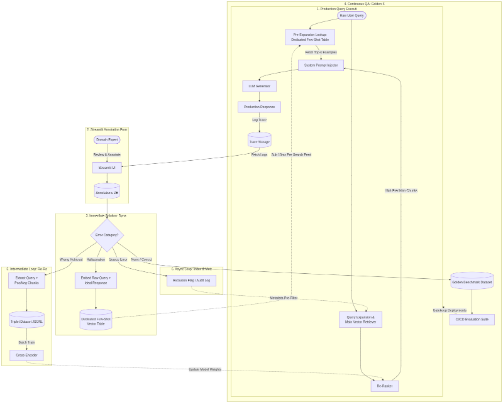
This loop decouples immediate behavioral fixes at runtime from longer-term retrieval optimization and automated quality gating.
Detailed System Breakdown
Ingestion via Streamlit Triage
A lightweight Streamlit interface presents logged queries, retrieved semantic chunks (with individual chunk IDs), and LLM outputs side-by-side. When a domain expert marks a query as a Hallucination, selects the relevant chunks, and inputs an Ideal Grounded Response, the application routes the structured payload directly into downstream stores.
Priority 1: Sub-10ms Dynamic Few-Shotting
When a hallucination fix is logged, the system embeds the raw user query and ideal response pair into a dedicated, low-latency Few-Shot Vector Table.
At runtime:
- Before query expansion or document search occurs, the production pipeline runs a sub-10ms similarity lookup against this table using the raw user vector.
- If a match exceeds a set threshold (e.g., cosine distance $\ge 0.82$), the top historical corrections ($k=2$) are injected into the system prompt as positive demonstrations.
- Performing this lookup before query expansion maintains intent matching precision, enforcing refusal rules and domain formatting without requiring model retraining.
Priority 2 & 3: Search Precision & Corpus Hygiene
- Re-Ranker Tuning: When experts flag retrieval failures, the system compiles contrastive triplets:
(User Query, Expert-Selected Chunk [Pos], Noise Chunk [Neg]). Over time, this dataset is used to fine-tune a cross-encoder (e.g., BGE-Reranker) to filter domain noise before context reaches the LLM. - Metadata Patching: If an error stems from outdated or corrupt source texts, an exclusion flag is set in the chunk’s vector metadata to drop it during pre-retrieval filtering, while logging a remediation task for content maintainers.
Continuous Regression Testing
All expert-approved outputs populate a permanent Golden Benchmark Dataset. Before a new system prompt, embedding model, or LLM version is merged into production, an automated CI/CD pipeline evaluates the release against this golden set using key RAGAS metrics (Faithfulness, Context Precision, Context Recall, Answer Relevance). Deployments that drop below baseline thresholds are automatically held.
Core Engineering Outcomes
- Faster Remediation: Reduces time-to-fix for prompt-sensitive errors by deploying dynamic few-shot examples without full model retraining.
- Structured Data Collection: Daily expert annotations naturally build domain-specific training triplets and evaluation datasets over time.
- Clear Separation of Concerns: Software engineers maintain pipeline infrastructure while domain experts guide model behavior through a standardized review interface.

