Enterprise retrieval-augmented generation (RAG) systems frequently fail not in their ability to generate prose, but in their capacity to triage context under strict operational constraints.
In high-concurrency production environments, the traditional two-stage RAG setup—dense vector retrieval followed directly by autoregressive LLM synthesis or heavy cross-encoder reranking—introduces severe latency bottlenecks, unpredictable cost variance, and context window pollution.
To build deterministic, low-latency, and cost-resilient architectures, engineering teams are decoupling context judgment from context synthesis using System 1 decision models (such as the JEV and Laya architectures).
The Bottleneck of Autoregressive Context Filtering
Dense vector retrieval (bi-encoders) excels at global recall over large collections, but cosine similarity alone lacks fine-grained semantic discrimination. Vector search returns false positives: passages that share syntactic patterns or topical overlap with a user prompt, yet provide zero factual utility toward answering the core question.
The Trade-off Dilemma
- Unfiltered Context Flooding: Injecting top-k raw vector results (e.g., k = 15) directly into a generative frontier model pollutes the prompt. This triggers the lost-in-the-middle effect—where LLMs fail to surface facts buried between distractor text—while burning unnecessary input tokens on every turn of a multi-turn conversation.
- Cross-Encoder Reranking Latency: Running high-parameter cross-encoders or multi-turn autoregressive LLM calls to rank and prune passages introduces hundreds of milliseconds (or multiple seconds) of latency, blocking real-time chat streaming.
- Structured Tool/Query Gating Overhead: Asking a general-purpose LLM to output a JSON blob just to decide whether context is needed or whether an intent matches a tool schema consumes 50–150 tokens of generation time and risks syntax parsing failures.
Production systems require an intermediate step: sub-50ms deterministic context triage.
What Is a JEV-Class Decision Model?
Rooted in dual-process cognitive architecture, cognitive scientist Daniel Kahneman framed System 1 as rapid, intuitive pattern classification and System 2 as deliberate, compute-heavy reasoning.
Standard LLMs are treated as System 2 engines: they produce sequential tokens autoregressively. Conversely, JEV (Judgment Engine for Vectors / Typed Decisions) and its open-source counterpart Laya are non-autoregressive transformer encoder models (typically built on backbones like ModernBERT).
Instead of generating a text stream token-by-token, a JEV-class model evaluates a batch of structured classification criteria across candidate passages in a single forward pass.
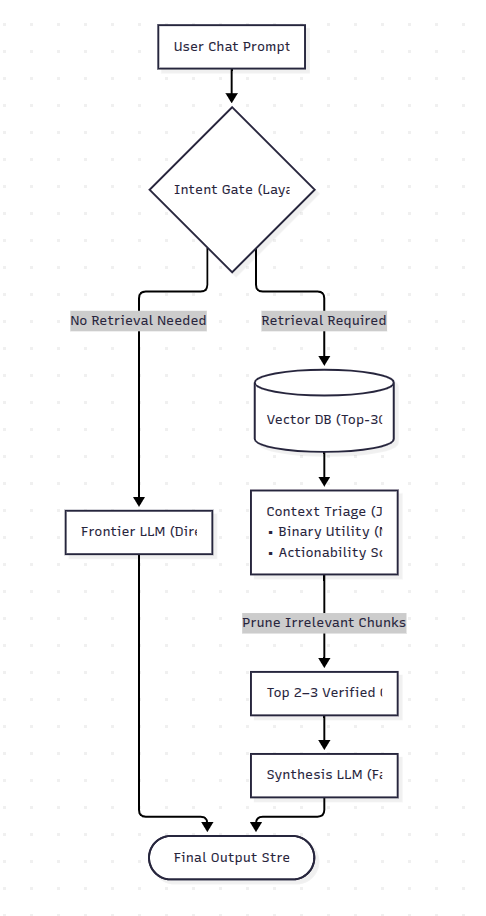
Core Primitive Outputs
Choice: Selects discrete categorizations or identifies the optimal retrieval target from an arbitrary set of candidate tools or collections.Noul: A calibrated boolean judgment (True/False) paired with a probability estimate and an explicit epistemic confidence score.Score: An ordinal rating along a defined scale (e.g.,["irrelevant", "tangential", "directly_actionable"]) measuring relevance or answer sufficiency.
Because these primitives do not decode tokens sequentially, their execution time is flat, deterministic, and bounded by transformer encoder matrix multiplication speeds.
Engineering Advantages in Production RAG
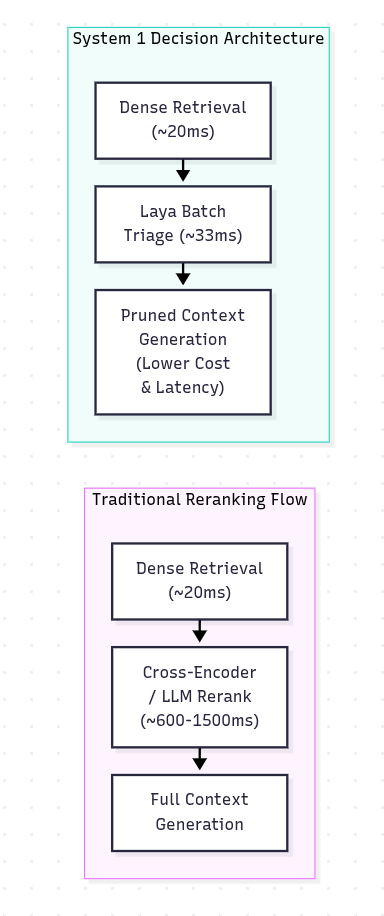
Ultra-Low Latency Batch Pre-Filtering
Evaluating 20 retrieved chunks using an autoregressive model requires sequential output generation or heavily parallelized concurrent API requests with high jitter. A local JEV model runs all 20 evaluations concurrently as a single batched tensor operation on GPU or fast CPU backbones, typically finishing in under 35 milliseconds.
Calibrated Confidence and Safety Thresholding
JEV-class models trained with Reinforcement Learning from Calibrated Decision (RLCD) produce strictly proper probabilities. If a candidate chunk receives a high utility score but an epistemic confidence metric below an operational threshold (tau < 0.70), the system can deterministically flag knowledge gaps, skip context injection, or trigger fallbacks without parsing ambiguous natural language refusals.
Deterministic Token Economics
By scrubbing 80–90% of raw candidate chunks before they reach the synthesis prompt, context windows remain lean. A pipeline that trims 12 irrelevant chunks of 400 tokens each saves ~4,800 input tokens per turn. In enterprise deployments handling tens of thousands of daily interactions, this directly reduces inference expenditure while improving throughput.
Model Landscape: Decision Models and High-Speed Rerankers
Teams implementing pre-filtering have distinct options spanning hosted APIs, self-hosted open-weights models, and specialized encoder architectures:
| Model | Ecosystem / Maintainer | Weights | Backbone / Architecture | Inference Latency | Core Strength |
Jev (jev-latest) | TypeSafe AI | Proprietary API | Custom Transformer Encoder | ~200–280 ms (via API) | Unbounded zero-shot tool selection, reasoning triage |
Laya (convaiinnovations/laya) | Convai Innovations | Open (Apache 2.0) | ModernBERT-large + Head (421M params) | ~30–40 ms (Local GPU) | Calibrated noul/score primitives, native local serving |
| Laya Multilingual | Convai Innovations | Open (Apache 2.0) | mmBERT-base + Head (322M params, 8k context) | ~35–50 ms (Local GPU) | Native multi-language semantic triage and routing |
| BGE-Reranker-v2-m3 | BAAI | Open (Apache 2.0) | XLM-RoBERTa (560M params) | ~40–60 ms (Local GPU) | High-accuracy dense cross-encoder scoring |
| Cohere Rerank 3.5 | Cohere | Proprietary API | Multi-stage Cross-Encoder | ~120–180 ms (via API) | Turnkey enterprise reranking across heterogeneous data types |
Implementation Guide: Deploying Laya with PydanticAI
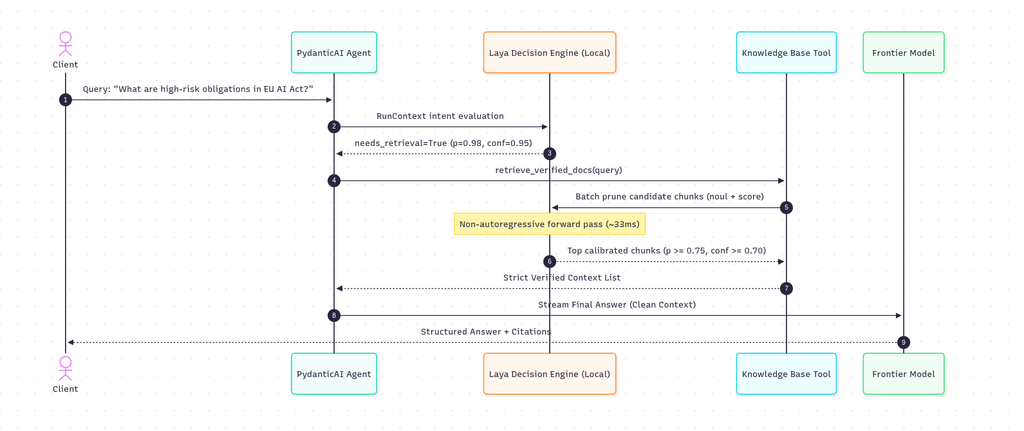
Laya pairs naturally with PydanticAI by acting as a deterministic dependency in RunContext. Rather than giving an agent raw tool access to flood context or asking an LLM to self-evaluate relevance, Laya acts as a type-safe gatekeeper:
- It evaluates whether retrieval is needed via
noulbefore any tool executes. - It prunes retrieved chunks in parallel in the agent tool body, returning only high-confidence citations.
Step 1: Environment Setup
pip install -U pydantic-ai laya torch transformers accelerate
Step 2: Full PydanticAI Production Implementation
from __future__ import annotations

import asyncio
from dataclasses import dataclass
from typing import List
from laya import Router
from pydantic import BaseModel, Field
from pydantic_ai import Agent, RunContext


# 1. Domain Models for Knowledge Base & Output
class RetrievedDoc(BaseModel):
    doc_id: str
    content: str


class VerifiedCitation(BaseModel):
    doc_id: str
    content: str
    relevance_prob: float
    confidence: float
    rank_score: int


class RAGResponse(BaseModel):
    answer: str = Field(description="Direct, factual answer synthesized from verified citations.")
    citations: List[str] = Field(default_factory=list, description="List of verified document IDs used.")


# 2. Agent Dependencies: Injecting Local Laya Router & Mock DB
@dataclass
class RAGDependencies:
    router: Router
    raw_database: List[RetrievedDoc]


# 3. Instantiate PydanticAI Agent
rag_agent = Agent(
    "openai:gpt-4o-mini",
    deps_type=RAGDependencies,
    result_type=RAGResponse,
    system_prompt=(
        "You are an enterprise technical assistant. Answer the user prompt strictly "
        "using the verified documents retrieved by your tools. Do not hallucinate."
    ),
)


# 4. Agent Tool: Context Retrieval with Local Laya Pre-Filtering
@rag_agent.tool
async def retrieve_verified_knowledge(
    ctx: RunContext[RAGDependencies], query: str
) -> List[VerifiedCitation]:
    """Retrieve and deterministically pre-filter knowledge chunks relevant to the query."""
    router = ctx.deps.router
    candidates = ctx.deps.raw_database

    decision_spec = {
        "is_directly_relevant": {
            "type": "noul",
            "instructions": f"Does this document snippet provide factual answers or rules for: '{query}'?",
        },
        "actionability": {
            "type": "score",
            "instructions": f"Rate technical actionability for: '{query}'",
            "scale": ["irrelevant", "supporting_context", "primary_fact"],
        },
    }

    verified_chunks: List[VerifiedCitation] = []

    # Fast non-autoregressive triage across all candidates
    for item in candidates:
        evaluation_state = f"Query: {query}\nDocument: {item.content}"

        # Executes in ~33ms per check on local GPU/ModernBERT
        decision = router.predict(evaluation_state, decision_spec)

        noul_prob = decision["is_directly_relevant"]["noul"]
        confidence = decision["is_directly_relevant"]["confidence"]
        score_val = decision["actionability"]["value"]

        # Calibrated safety threshold: keep only high-confidence factual matches
        if noul_prob >= 0.75 and confidence >= 0.70:
            verified_chunks.append(
                VerifiedCitation(
                    doc_id=item.doc_id,
                    content=item.content,
                    relevance_prob=round(noul_prob, 3),
                    confidence=round(confidence, 3),
                    rank_score=score_val,
                )
            )

    # Sort deterministically by actionability score
    verified_chunks.sort(key=lambda x: x.rank_score, reverse=True)
    return verified_chunks[:3]


# 5. Pipeline Execution
async def main():
    # Initialize the local Laya engine
    local_laya = Router(preload=True)

    # Sample corpus simulating a raw vector search return (containing distractors)
    mock_vector_results = [
        RetrievedDoc(
            doc_id="eu_ai_act_art9",
            content="High-risk AI systems must establish and maintain a continuous risk management system throughout their lifecycle.",
        ),
        RetrievedDoc(
            doc_id="eu_ai_act_art14",
            content="High-risk AI systems shall be designed to be overseen by natural persons during the period in which they are in use.",
        ),
        RetrievedDoc(
            doc_id="aws_s3_standard",
            content="Amazon S3 Standard offers high durability, availability, and performance object storage for frequently accessed data.",
        ),
        RetrievedDoc(
            doc_id="postgres_wal",
            content="PostgreSQL write-ahead logging guarantees data integrity by logging changes before writing them to data files.",
        ),
    ]

    deps = RAGDependencies(router=local_laya, raw_database=mock_vector_results)

    query = "What operational safeguards are mandated for high-risk AI models under EU regulations?"
    print(f"\n[Query]: {query}\n" + "-" * 70)

    result = await rag_agent.run(query, deps=deps)

    print("\n[Structured Agent Output]:")
    print(f"Answer: {result.data.answer}")
    print(f"Cited Sources: {result.data.citations}")


if __name__ == "__main__":
    asyncio.run(main())
Architectural Summary
Treating generative LLMs as universal Swiss Army knives introduces latency and cost vulnerabilities. Embedding non-autoregressive decision models like Laya into RAG pipelines enforces clean separation of concerns:
- Vector Engines maximize recall over high-dimensional text corpora.
- System 1 Decision Models deliver sub-40ms deterministic context pruning and intent classification with calibrated confidence.
- Generative LLMs synthesize verified facts into clear human communication.
By establishing deterministic triage before generative synthesis, production AI systems maintain speed, lower operational overhead, and prevent hallucinations at scale.
