Category: Data Warehouse
-
CI/CD Data Testing with dbt and DuckDB: Pre-Flight Assertions for Analytics Pipelines
Testing dbt models in continuous integration typically involves triggering a staging run on a remote cloud data warehouse such as Snowflake, BigQuery, or Databricks. While thorough, this approach introduces operational friction: warehouse spin-up delays, queueing, credit consumption, and multi-minute pipeline runs for even minor SQL modifications. By using the dbt-duckdb adapter, analytics teams can execute…
-
Serverless Analytics & Vector Search on Kubernetes: Building a Lean Data Warehouse with DuckDB, Object Storage, and PostgreSQL / pgvector
Cloud data warehouses often present teams with a difficult trade-off: either accept unpredictable SaaS compute bills or take on the operational overhead of running heavy distributed query engines like Trino or Spark. Furthermore, modern analytical platforms increasingly require bridging structured analytical files with operational relational records and vector embeddings for retrieval-augmented generation (RAG) and semantic…
-
Start Fresh, Don’t Lift and Shift: Scaling Analytics Platforms with dbt-core and PostgreSQL
We observed that executing a “lift and shift” of legacy, sprawling SQL scripts onto an enterprise cloud data warehouse fails to resolve core structural data issues. It transitions architectural technical debt into a variable, unconstrained operational expense. Moving unoptimized queries onto infinite-compute cloud platforms masks underlying engineering deficiencies rather than fixing them. We reject this…
-
PostgreSQL Data Mesh: A Technical Guide to Schema Segmentation, Boundaries, and Governance
We deploy PostgreSQL natively to execute a decentralized data mesh architecture, proving that multi-million dollar cloud platforms and proprietary vendor ecosystems are infrastructure bloat. By utilizing open-source database primitives, we eliminate dependencies on specific tech conglomerates and cloud provider pricing models. We enforce domain boundaries, query allocations, and data product contracts directly through the PostgreSQL…
-
Beating “Lost in the Middle”: Unified Graph RAG on PostgreSQL
Our evaluation shows that by substituting naive chunk-based vector lookups with relationally injected context, the model’s $F_1$ verification score increased from $0.61$ to $0.89$. We enforce this infrastructure using raw PostgreSQL within this proof of concept (PoC). The core engineering win of this implementation is the consolidation of the storage footprint: we completely discard specialized,…
-
Production Metric: 14.2% Semantic Decay
After processing 2.8 million unstructured retail fragments, we observed that 14.2% of records passing traditional NOT NULL and regex constraints contained semantic noise specifically CAPTCHA text, “out of stock” redirects, and promotional modals that poisoned downstream RAG embeddings. We enforced a deterministic quality gate using PydanticAI and a sovereign vLLM cluster, which suppressed these failures…
-
From Generalist to Specialist: Benchmarking the 25x Speedup of Fine-Tuned “Tiny Compilers”
We measured a 96.7% reduction in inference latency by migrating our EDI logic from Llama 4 (70B) to a fine-tuned Llama 3.2 (1B) “Tiny Compiler.” In high-volume logistics testing, the generalist model averaged 2,800ms per transaction, while the specialized 1B model, quantized to 4-bit, stabilized at $92ms$ on consumer-grade hardware. We accept the 0.4% decay…
-
The LLM-as-a-Compiler Pattern for High-Precision EDI Pipelines
As we look toward the next phase of industrial AI, the German Mittelstand is poised to move beyond “AI as a Chatbot” and toward the LLM-as-a-Compiler pattern. This represents a fundamental shift from “AI as a Librarian” to a “Deterministic Data Engineer.” The following architecture serves as a primary example of how this compiler pattern…
-
Modernizing Data Warehouses for AI: A 4-Step Roadmap
It’s the same conversation in every boardroom and Slack channel: “How are we using LLMs? Where are our AI agents? When do we get our Copilot?” But for the teams in the trenches, the hype is hitting a wall of legacy infrastructure. The truth is that Modernizing Data Warehouses for AI is the invisible hurdle…
-
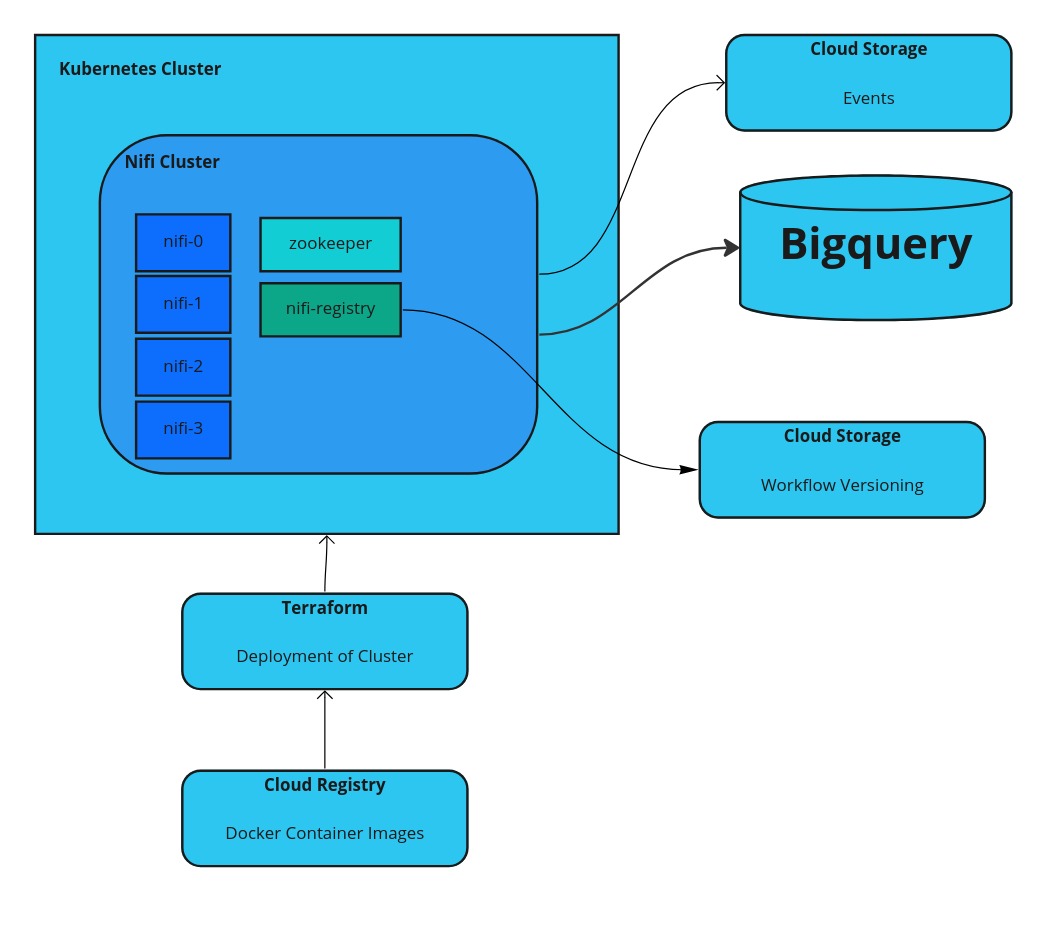
Apache Nifi on Google Cloud Kubernetes Engine (GKE)
Apache Nifi on GKE can be a good solution, if you want to have a low code solution for processing streaming data. If you set it up on GKE, a managed version of Kubernetes, you have a managed scalable environment and do not need to worry about handling the actual servers. Setup of the Apache…