Executive & Engineering Summary
- The Distributed Tax: Over 90% of enterprise analytical datasets sit well below 5 TB compressed—yet teams routinely pay hyperscaler premiums for distributed compute clusters, cross-AZ networking, and idle warehouse spin-ups built for Google-scale problems.
- Vertical Scale Beats Distributed Overhead: A single modern NVMe-backed bare-metal node or dedicated VM running DuckDB over Apache Parquet / Iceberg eliminates network shuffles and JVM overhead, delivering sub-second analytical queries at a fraction of SaaS consumption pricing.
- Air-Gapped Agentic AI via MCP: By pairing DuckDB with a local Model Context Protocol (MCP) server, internal AI agents and self-hosted LLMs can safely query structured enterprise data with deterministic guardrails, full audit lineage, and zero data egress.
For the past decade, modern data engineering operated under an unquestioned default: if you want fast analytics and AI readiness, you replicate your operational databases into a cloud data warehouse. Snowflake, Google BigQuery, and Databricks turned that pattern into the industry standard.
In our recent infrastructure audits across European enterprises and scale-ups, however, a clear inflection point has emerged. Cloud warehouse bills are compounding every quarter, while actual active data volumes remain surprisingly flat. Worse, strict data governance mandates, the EU AI Act, and vendor lock-in concerns are stalling production AI deployments before they ever leave staging.
The underlying hardware and open-source assumptions that justified distributed cloud warehouses ten years ago no longer hold. When your entire analytical warehouse fits on fast local NVMe flash, distributing queries across a network cluster isn’t an optimization—it’s a tax.
1. The Petabyte Fallacy in Modern Data Engineering
Distributed query engines like Apache Spark, Trino, and multi-cluster cloud warehouses were engineered to solve a specific problem: datasets too large to fit on a single machine.
In practice, once transactional data from ERP, CRM, and PostgreSQL/SQL Server systems is deduplicated, normalized, and compressed into ZSTD-encoded Parquet files, the core analytical footprint for most mid-to-large enterprises lands between 200 GB and 4 TB.
Meanwhile, single-node hardware has scaled dramatically:
- A dedicated bare-metal server or sovereign cloud instance with 64 vCPUs, 512 GB ECC RAM, and 8 TB enterprise NVMe storage runs under $650 / €600 per month with flat, predictable billing.
- Reading columnar data directly from local NVMe into CPU cache operates orders of magnitude faster than serializing data across cloud object storage and worker nodes.
If your working set fits on one node, distributed execution introduces network latency, serialization overhead, and per-second compute metering for zero architectural gain.
2. Reference Architecture: The Sovereign Lake Stack
Instead of continuously shipping raw operational data out to third-party SaaS platforms, the Sovereign Lake pattern brings an embedded analytical engine and an agentic control plane directly to where your data already lives.
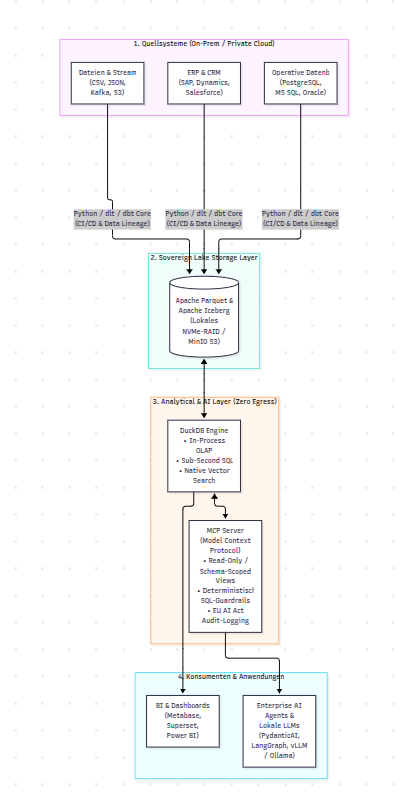
How the Four Layers Work Together
- Zero-Lock-In Storage (Apache Parquet & Iceberg): Data is ingested via lightweight Python pipelines (
dltor custom connectors) and stored in open columnar formats on local NVMe or self-hosted S3-compatible storage (MinIO). You own the files, the metadata, and the storage lifecycle. - Vectorized Execution with DuckDB: DuckDB runs in-process without a heavy daemon or JVM footprint. Its vectorized execution engine saturates modern multi-core CPUs, routinely outperforming medium-sized cloud warehouse clusters on joins, window functions, and multi-terabyte aggregations.
- Software-Engineered Transformations (dbt Core): Every transformation is version-controlled in Git, tested in CI/CD, and documented with column-level lineage—giving compliance and audit teams deterministic reproducibility.
- Controlled AI Access via MCP (Model Context Protocol): Rather than giving an LLM direct database credentials or piping sensitive tables to external model APIs, internal agents interact strictly through a hardened MCP server.
Model Your 3-Year Infrastructure Savings
Cloud Data Warehouse vs. Sovereign Lake (5 TB Active Data, 25 BI Users & AI Workloads)
Benchmark your current Snowflake or BigQuery spend against a dedicated Sovereign Lake deployment—factoring in compute credit scaling, storage growth, and data egress fees.
Launch the Interactive 3-Year TCO Calculator (data-do.de/sovereign-lake)
3. 3-Year TCO Breakdown: Consumption Billing vs. Predictable Infrastructure
Consumption-based cloud pricing looks inexpensive during initial prototyping. Costs escalate once BI dashboards refresh every 15 minutes, data science teams run ad-hoc scans, and vector/AI workloads enter production.
| 36-Month Cost Driver | Cloud Data Warehouse (Snowflake / BigQuery) | DATA DO Sovereign Lake (On-Prem / Sovereign Cloud) |
| Compute & Query Credits | ~$1,900 – $3,800 / mo (usage-dependent) | $0 variable query fees (dedicated compute) |
| Storage (5 TB Active + Snapshots) | ~$380 – $650 / mo | Included (NVMe primary + encrypted S3 backup) |
| Data Egress & Cross-Region Transfer | ~$250 – $850 / mo | $0 (all traffic stays inside your network) |
| Deployment, Hardening & Ops | Internal DevOps overhead / cloud consulting | Fixed-fee deployment + optional Managed Ops |
| 3-Year Total Cost of Ownership | ~$100,000 – $190,000 | ~$40,000 – $58,000 |
| Data Sovereignty & Regulatory Risk | Cross-border transfer assessments required | 100% Air-Gapped / GDPR & EU AI Act Ready |
Baseline assumption: 5 TB compressed analytical dataset, hourly incremental ETL runs, 25 active BI consumers, and internal agentic RAG/SQL workloads.
4. Closing the AI Governance Gap with MCP
The biggest blocker to enterprise AI adoption isn’t model quality—it’s data boundary security. Security and Data Protection Officers (DPOs) rightly reject architectures that stream raw financial, HR, or customer records into external multi-tenant APIs.
The Model Context Protocol (MCP) provides a clean, standardized boundary between your data lake and your AI layer:
- Least-Privilege Tool Exposure: Your MCP server exposes curated semantic views and read-only query tools—never raw underlying tables or write permissions.
- Deterministic Guardrails: Before a self-hosted LLM (such as Llama, Mistral, or Qwen running on local GPU infrastructure via vLLM) executes a query, the MCP layer enforces strict SQL validation, timeout ceilings, and row-level limits.
- Out-of-the-Box Auditability: Every tool invocation, generated SQL statement, and user context is logged immutably—satisfying strict enterprise audit requirements and EU AI Act traceability standards.
5. Validate on Your Own Data in 5 Days
Reclaiming control over your data stack doesn’t mean going back to legacy monolithic databases. Combining Apache Parquet, DuckDB, dbt Core, and MCP gives engineering teams modern cloud ergonomics with bare-metal speed, flat unit economics, and complete data sovereignty.
If you’re evaluating an exit from unpredictable cloud warehouse bills or need a compliant foundation for internal AI agents, explore the full technical blueprint on our Sovereign Lake hub:
- Interactive Architecture Blueprint for infrastructure and security reviews
- 3-Year TCO Calculator comparing Snowflake/BigQuery against fixed-cost deployments
- Security & DPO Compliance FAQ covering zero-egress guarantees, GDPR, and EU AI Act readiness
- 5-Day Proof of Concept (PoC) benchmarked directly on your schemas and workloads
Explore the Architecture & 3-Year TCO Calculator at data-do.de/sovereign-lake

